By Nam Nguyen, Founder of Namhaha Media. My team runs affiliate campaigns across 7 partner networks, managed $4M in ad spend in the first half of 2026, and has driven 500,000+ customers to partner brands over 7 years. Published July 6, 2026 · Updated July 6, 2026 · 14 min read
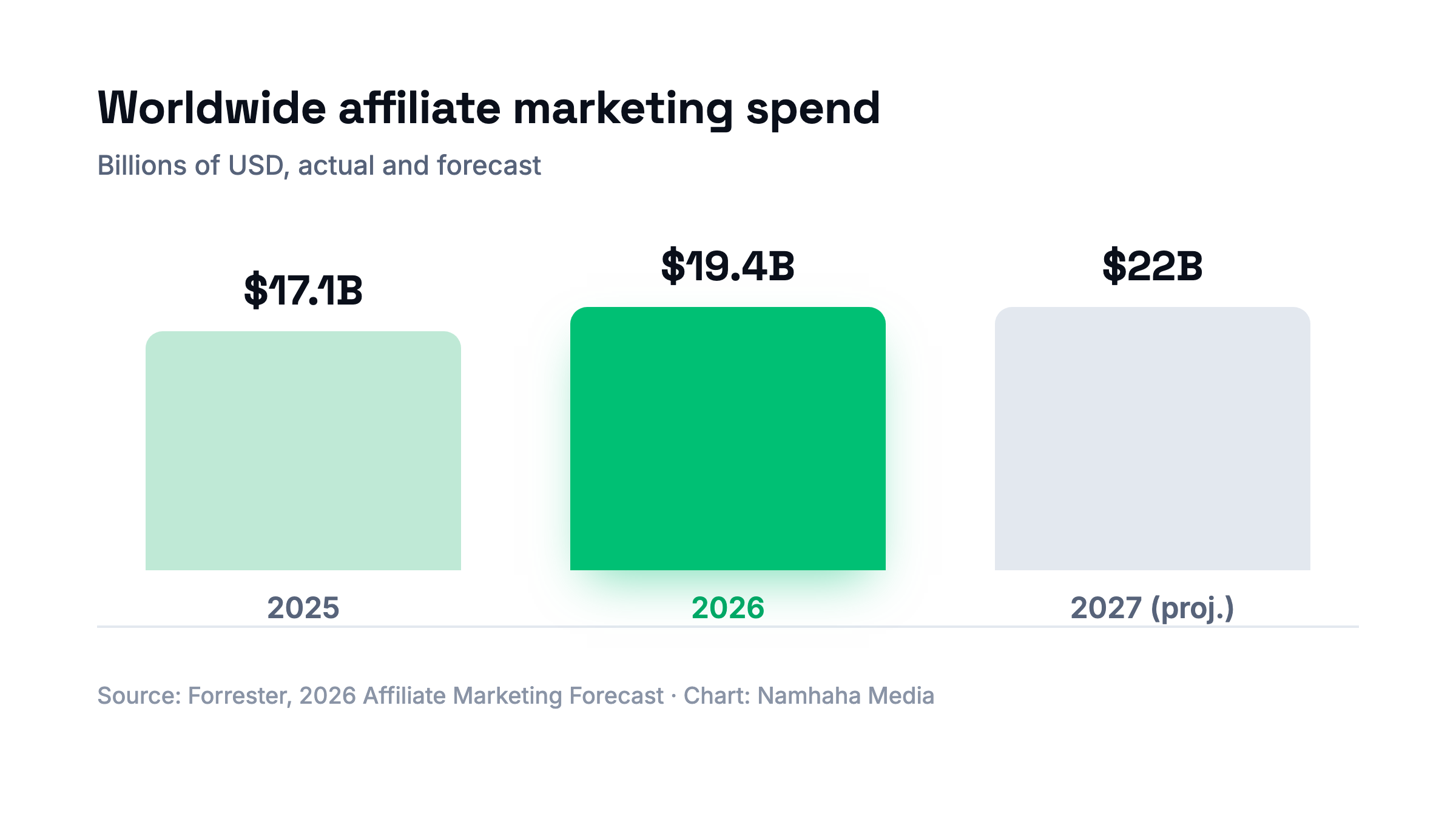
The five affiliate marketing trends that matter in 2026: partner recruitment has replaced software as the bottleneck, media buyers have overtaken bloggers as the partners that move revenue, server-side tracking has become the attribution baseline, payment speed now decides who joins your program, and AI search is rewriting which affiliate content wins. Worldwide affiliate spend reaches $19.4 billion in 2026, up from $17.1 billion in 2025 (Forrester, 2026 Affiliate Marketing Forecast).
One more thing before the details: most trend articles in this category are written by people selling affiliate software. I am the partner your new program is trying to recruit. My team evaluates hundreds of affiliate programs every month, joins the good ones, and quietly skips the rest.
TL;DR
- Worldwide affiliate spend hits $19.4 billion in 2026, up from $17.1 billion in 2025 (Forrester, 2026 Affiliate Marketing Forecast).
- Recruiting productive partners is the hard part now; 5% of affiliates drive roughly 80% of program results (affiliate researcher Geno Prussakov’s 5-80 rule).
- Serious partners judge your program on three numbers: payout percentage, attribution window in days, and days-to-payment.
- Affiliate programs that rely on browser cookies alone undercount partner sales; server-side (postback) attribution is the 2026 baseline.
- Partners screen programs with software before a human ever reads your terms. Write your program page for both audiences.
Why are so many companies adding affiliate programs in 2026?
Affiliate spend keeps outgrowing most other acquisition channels: Forrester’s 2026 Affiliate Marketing Forecast puts worldwide affiliate spend at $19.4 billion in 2026, up from $17.1 billion in 2025 and on track for $22 billion by 2027.
The logic is easy to like. You pay after the customer arrives, not before, and in a year when paid-media costs keep climbing, “commission on results” is the easiest budget line to defend.
Here is what the software vendors skip. Roughly 70% of affiliate programs generate less than $500 a month, and most failed programs die within their first six months (Synergist Digital Media, 2025). Opening the program is the cheapest step you will ever take. The gap between the winners and the graveyard is not the tracking tool. It is everything below.
Trend 1: Why did the bottleneck move from software to partner recruitment?
In 2026 a company can launch a technically perfect affiliate program in one afternoon, which is why a technically perfect program no longer differentiates anything. Dub Partners, Rewardful, Tolt, PartnerStack, Impact, Awin: the tooling is mature, cheap, and largely interchangeable at launch. Every competitor in your category has access to the same stack.
Productive partners are the scarce resource. A healthy SaaS affiliate program sees only 10-20% of its affiliates actively driving clicks or sales in a given month (Rewardful, State of SaaS Affiliate Programs, accessed July 2026). Affiliate researcher Geno Prussakov, who has published program benchmarks since the late 2000s, compressed that concentration into the 5-80 rule: 5% of your affiliates will drive about 80% of your results.
I see this from the inside. When my team joins a new program, the welcome email usually celebrates like we are partner number 300. Then I look at the leaderboard data some networks expose, and it is a desert: hundreds of signups, a handful of names producing revenue. The program owner spent a launch quarter collecting ghosts.
So skip the question “which affiliate software should we pick?” Ask instead: who are the 15 partners that will carry this program, and what would make them choose us over the 40 other programs in our category? Answer that before you buy anything.
Trend 2: Why do media-buyer affiliates matter more than bloggers in 2026?
The affiliate stereotype is a blogger with a review site, but the partners moving revenue for AI and SaaS companies in 2026 are media buyers who treat your offer like their own product launch. They run Google, Bing, Meta, and YouTube traffic to your funnel, front the ad budget themselves, and get paid only when your customer converts.
I know because that is what we do. In the first half of 2026 my team put $4M of our own ad spend behind partner offers across four ad platforms. We rarely touch brand-name keywords; we buy the demand your future customers type when they do not know you exist yet: competitor comparisons, “best X for Y” queries, problem searches.
On one enterprise network alone, Namhaha Media’s internal watchlist tracks 763 affiliate programs where at least one partner has been running Google Ads for 30 or more consecutive days (internal tracking, June 2026). Thirty days of continuous spend means the math works. That is the strongest program-quality signal I know of, and no network dashboard will show it to you.
Designing for media buyers means three things:
- Publish a paid-traffic policy. Say clearly what is allowed: paid search on non-branded terms, social ads, comparison landing pages. Vague terms read as “we will claw back your commissions later,” and serious buyers leave.
- Give partners a funnel, not just a link. The programs we scale hardest give us dedicated landing pages or at least allow pre-landers.
- Expect attribution questions before creative questions. A media buyer’s first three questions are about tracking and payment, never about banner sizes.
(Aside: bloggers still matter, especially now that AI search engines quote them. But bloggers compound slowly, while media buyers show you within 60 days whether your unit economics survive cold traffic. You want both, and they need different things from you.)
Trend 3: Why is server-side tracking now the baseline for affiliate programs?
An affiliate program that attributes sales with a browser cookie alone is underpaying its partners, and the partners find out first. Apple’s Intelligent Tracking Prevention has capped client-side cookies at 7 days for years, and at 24 hours for links carrying tracking decoration (WebKit.org). Ad blockers and iOS privacy prompts cut deeper. Every conversion the cookie drops is a commission a partner earned and never sees.
Let me make that concrete. Early in one campaign, our click logs showed we had sent a brand roughly 100 trial signups in a period where their dashboard credited us with 60. We raised it, politely. The response was a shrug, so the budget moved to a competitor’s program that measured server-side, and that competitor got the next twelve months of our spend. Nobody in that brand’s marketing team ever knew the revenue existed, because their own tracking never saw it.
Partners compare notes on measurement constantly. The 2026 baseline is server-side: postback URLs (S2S), server-side conversion APIs, and first-party tracking links that survive browsers. We run our own campaigns this way; conversions fire from the server into each ad platform’s API, so the partner, the brand, and the platform all see the same sale.
If you are launching now, four settings decide whether measurement helps you or bleeds you unnoticed:
- Choose a platform that supports postback/webhook attribution out of the box, not cookie-only.
- Offer at least a 30-day attribution window. A 7-day cookie on a SaaS product with a 14-day trial is self-sabotage.
- Send conversion events server-side to partners who run paid traffic, so they can optimize ad accounts on real data.
- Document all of it on your program page. “Server-side attribution, 30-day window, NET-15 payouts” is recruiting copy, not fine print.
Trend 4: How did payment speed become a recruiting weapon?
The slowest mainstream affiliate programs take 70+ days to pay a commission after the sale, while the fastest pay weekly, based on Namhaha Media’s tracking of programs across enterprise networks (June 2026). Partners now see this number before they apply. At least one major network exposes average payment time as a field in its partner API, next to approval rate and earnings-per-click; we pull it programmatically, and we sort by it.
Run the partner’s math. A media buyer fronts ad spend in January, and on a 70-day cycle the commission for a January sale arrives in April. That partner is floating three months of the brand’s customer acquisition cost out of their own pocket.
They respond the way anyone would. Bid conservatively on the slow payer, or pick the competitor who pays NET-15. I still promote a few slow payers when the commission is exceptional, but I size those budgets smaller, and every serious media buyer I know runs the same arithmetic before their first click.
Affiliate program payment terms vs. the partners they attract (2026):
| Payment cycle | Which affiliates you attract | Verdict |
|---|---|---|
| Weekly or NET-15 | Media buyers who scale spend fast | Best for growth |
| NET-30 | Most professional affiliates | The 2026 standard |
| NET-60 | Content sites without cash-flow pressure | Slow compounding only |
| 70+ days | Affiliates who have not checked yet | Quiet recruitment freeze |
The trap for new programs: long payment cycles feel “safe” against refunds and fraud. Solve that with a hold on unverified conversions, not by making every good partner finance your working capital.
Trend 5: How does AI search change which affiliate content wins?
Gartner predicted in February 2024 that traditional search engine volume would drop 25% by 2026 as AI chatbots become substitute answer engines (Gartner press release, February 19, 2024), and inside affiliate programs that shift has a specific consequence: the content partners worth recruiting are the ones AI engines cite. ChatGPT Search, Perplexity, and Google’s AI Overviews summarize and quote instead of listing ten blue links.
What gets cited is content with verifiable specifics: named sources, numbers with dates, first-hand testing. Generic “10 best tools” listicles rewritten from other listicles are exactly what these engines skip. We watch this from the demand side, because the comparison pages we build for partner offers only earn AI citations when they carry something checkable.
For a program owner the move is simple, and almost nobody makes it. Give partners real material: internal benchmarks, screenshots, usage data, founder quotes. A partner armed with specifics gets quoted inside AI answers; a partner paraphrasing your homepage does not. And when a small site applies to your program, ask where their content shows up in AI answers instead of staring at their pageview count. A site with 3,000 monthly visitors that Perplexity cites in your category can out-convert a general site with 300,000.
My honest take: this is the trend most program owners will read, nod at, and ignore, because “give partners proprietary material” requires internal work that “raise the commission 5%” does not. The programs that do the work will own AI-search distribution in their category for years.
What do affiliates check before joining your program? (Steal this checklist)
My team screens affiliate programs with software because the volume is too high to do by hand, and the screening list below came from years of joining programs that wasted our time. Every item is something you control on day one:
- A commission I can model. Flat or recurring, on what base, for how long. Recurring SaaS commissions of 20-30% for 12+ months beat a large one-time bounty for us, because they reward retention work.
- Attribution method. Postback/server-side or cookie-only? What window? (See Trend 3.)
- Days to payment. Under 30 is competitive. Over 60 attracts only partners without cash-flow pressure. (See Trend 4.)
- A human who answers. We email every program before scaling. A reply within 72 hours carrying real answers predicts program quality better than any commission number.
- Terms a machine can parse. Our automation reads your program page before I do. If your paid-traffic policy, cookie window, and payout terms are buried in a PDF or missing, you fail screening without a human ever seeing you.
That fifth point surprises every founder I mention it to, so let me say it plainly. Partners now use automation to discover, screen, and even apply to programs at scale; my team files hundreds of applications a month this way. The programs with machine-readable terms get the applications from serious operators. The rest get silence and wonder why.
When should you NOT launch an affiliate program?
An affiliate program amplifies unit economics; it does not create them. After seven years on the partner side, I would tell a founder to wait if any of these are true:
- Your funnel does not convert your own traffic yet. If your paid campaigns cannot turn a click into a customer profitably, partners cannot either. We test a brand’s own funnel before committing budget, and a leaky funnel is an instant pass.
- Your LTV cannot fund a real commission. If paying 20-30% recurring (SaaS) or 25-50% of first order (DTC) breaks your math, the program will attract nobody worth having.
- You cannot pay within 30 days. See Trend 4. If cash flow forces 60+ day payouts, fix that first.
- Nobody owns it internally. A program without an owner stops answering email in month two. Partners notice within weeks, and word travels through partner communities faster than most founders expect.
None of these are permanent. But launching before they are fixed burns your first impression with exactly the 5% of partners who would have carried the program, and in most niches that group all knows each other.
What did 7 years on the partner side teach me?
Namhaha Media’s first two years were fintech offers, where we drove 300,000 users and learned attribution the hard way: our click logs and the network dashboards kept telling two different stories, and the difference was our margin. We moved into health and wellness, pivoted to AI and SaaS in 2024, and have now sent 500,000+ customers to partner brands.
Across all three niches one pattern never changed. The brands that grew fastest through partners rarely paid the highest commission; their programs were simply run by someone who understood the partner’s economics, meaning fast payment, honest attribution, real answers by email, and terms you could read in two minutes.
That is the entire secret, and it is why “trends” is almost the wrong word for this article. The tooling changes yearly. The winning behavior has been identical since our fintech days; 2026 just punishes laggards faster, because partners now share data and screen programs with software.
Where Namhaha Media fits (and where we do not)
We are a growth partner for AI and SaaS companies, and this article doubles as a disclosure: we make money as an affiliate ourselves, so everything above is how we genuinely allocate budget. It is also why brands hire us. We grow their revenue with the same playbook we run on our own campaigns, from customer research to paid acquisition across Google, YouTube, Meta, and Bing. We do not sell tracking software or own a network, so we have no stake in which platform you pick.
Concretely, an engagement starts with the screening report from the checklist above, then an agreed target, then we build and run the acquisition side while you keep ownership of the program. One direct contact, and a written insight report on what your customers respond to, every week.
If you are planning an affiliate program, or you launched one and the leaderboard is a desert, that is the conversation we are built for.
Talk to the team that evaluates affiliate programs for a living
Send your program page. You get back the same screening our software runs on every program we join: where you fail, what we would fix first, and whether we would personally promote you. Free, and no slide deck.
FAQ: launching an affiliate program in 2026
What commission rate should a SaaS affiliate program offer in 2026?
A competitive SaaS affiliate commission in 2026 is 20-30% recurring for 12 months to lifetime. One-time bounties suit high-ACV products with sales-assisted closes, but recurring commissions attract affiliates who care about the quality of customers they send, not just volume (Namhaha Media screening data across 7 networks, 2026).
How long does a new affiliate program take to produce meaningful revenue?
A new affiliate program that actively recruits partners typically needs one to two quarters before commissions become meaningful, because most program revenue comes from a handful of partners (the 5-80 rule). Programs that launch and wait usually stay under $500 a month, where roughly 70% of all programs sit (Synergist Digital Media, 2025).
Do I need an affiliate network, or is a self-hosted tool enough?
Start with the lightest tool that supports server-side attribution and fast payouts; add an enterprise network later for discovery. Network marketplaces are where partners’ screening automation looks first, while self-hosted tools give lower fees and more control but zero built-in reach.
How do I attract media-buyer affiliates specifically?
Media buyers join affiliate programs that publish an explicit paid-traffic policy, offer a 30-day server-side attribution window, pay NET-15 or NET-30, and provide landing pages or allow pre-landers. Then show up where they already evaluate offers: network marketplaces with complete terms, and direct outreach that leads with your funnel metrics.
How do I protect my brand while allowing paid search?
Restrict branded keywords and trademark-plus terms in writing, allow everything else, and enforce with monitoring rather than blanket bans. Affiliates bidding your brand name add little incremental value, while affiliates bidding competitor and problem keywords bring customers who did not know you existed. Ban the first, encourage the second.
About the author
Nam Nguyen is the founder of Namhaha Media, a growth partner for AI and SaaS companies. His team has spent 7 years on the partner side of affiliate marketing across fintech, health, and software, managing $4M in ad spend in H1 2026 across Google, YouTube, Meta, and Bing, and driving 500,000+ customers to partner brands. Contact: namhahamediallc.com.
Sources
- Forrester, 2026 Affiliate Marketing Forecast: worldwide affiliate spend of $19.4B in 2026, $17.1B in 2025, $22B by 2027 (figures as reported in FirstPromoter’s statistics roundup and DigitalApplied’s 2026 data compilation)
- Gartner, press release, February 19, 2024: traditional search engine volume predicted to drop 25% by 2026 due to AI chatbots
- Rewardful, State of SaaS Affiliate Programs (accessed July 2026): active-affiliate benchmarks (10-20% of partners active monthly)
- Geno Prussakov, the “5-80 rule” of affiliate program concentration (long-running benchmark from his affiliate program research, accessed July 2026)
- Synergist Digital Media, Why Most Programs Fail (2025): ~70% of programs under $500/month; most failures within six months
- WebKit.org, Tracking Prevention: ITP 7-day / 24-hour cookie caps
- Namhaha Media internal tracking data, June 2026: 763-program watchlist, payment-time observations, screening benchmarks
Last updated: July 6, 2026