Category: Affiliate & Partnerships

  • Affiliate Program Page: What Partners Check in 2026

    Affiliate Program Page: What Partners Check in 2026

    By Nam Nguyen, Founder of Namhaha Media. My team puts $4M of our own ad spend per half-year behind partner brands across Google, YouTube, Meta, and Bing. Published July 7, 2026 · Updated July 7, 2026

    An affiliate program page in 2026 gets read twice, and the first reader is a script checking four fields: the commission base (recurring or one-time, on what revenue), the attribution window in days, the payment terms (threshold, schedule, method), and a written paid-traffic policy. Miss or fudge one and the page gets binned before anyone reads your hero copy. Commission Factory, part of the Awin group, now tells programs that AI-driven discovery is “a core part of the customer journey” and that partner-facing content must be structured for how machines interpret it (Commission Factory, March 2026).

    TL;DR – Four fields decide whether a partner applies: commission base, attribution window, payment terms, paid-traffic policy. If a script can’t pull them off the page, no human ever sees your offer. – Say whether commission recurs. 71% of SaaS affiliate programs now pay recurring (PartnerStack data via Digital Applied, 2026), so a bare “20%” fails the first parse. – Print the attribution window as a number. 38% of programs run 7-day or shorter windows now (AM Navigator survey via Digital Applied, 2026). – Put payout threshold, schedule, and methods on the page. Reversed sales and vanished balances are the stories affiliates swap in forums. – Publish an explicit six-clause paid-traffic policy. Media buyers read fuzzy PPC rules as future reversals and skip.

    Why Do Partners Screen Program Pages With Software Before Reading Them?

    The first reader of your affiliate program page in 2026 is a parser. A high-volume affiliate evaluates dozens or hundreds of programs a month, so you script the first pass: pull the page, extract the terms, bin anything incomplete. Commission Factory says as much: optimize structured assets and product data for how large language models read affiliate content (Commission Factory, March 2026).

    The filters are brutal on purpose. One working affiliate writes that many partners “won’t even touch affiliate programs” with cookie windows under 7 days (Trackdesk, March 2025). Hide your window behind “generous tracking” and the script files you with the sub-7-day programs anyway; hiding is usually what that phrase means.

    The page has one job: put four answers where a machine can lift them.

    What Must the Commission Section State to Pass the First Parse?

    A commission section passes screening only when one sentence carries rate, base, and duration, for example “25% of MRR, recurring, for the customer’s first 24 months.” The rate alone tells a partner almost nothing. In subscription programs, 70% of all commission events are renewal payments (LinkJolt, updated June 2026), so the base moves an affiliate’s earnings more than the headline number ever will.

    Across 96 real percentage-based campaigns, the median commission is 20%, with SaaS averaging 23.3% (LinkJolt, updated June 2026). 71% of SaaS programs pay recurring, benchmarked at 22.5% of MRR in year one, 14.2% in year two, and 8.1% from year three, and recurring programs generate 3.4x more partner-driven ARR over 36 months (PartnerStack data via Digital Applied, April 2026). That 3.4x is why partners ask about the base first.

    Don’t take my word for it. A published affiliate wishlist puts fixed recurring commission at the very top, ahead of everything else (LiveChat Partners, January 2025).

    How Long Does the Attribution Window Need to Be?

    Print the attribution window in days, because affiliates treat anything under 7 days as an automatic skip and anything unstated as concealment. The Trackdesk affiliate author wants a 7-day minimum and is “especially happy about 30+ day cookies,” with 30 days the recommended start and 60 to 90 days the typical SaaS range (Trackdesk, March 2025). The LiveChat Partners wishlist calls 30 days the minimum acceptable and 120 days ideal (LiveChat Partners, January 2025).

    Why verify? Because the industry burned them. In 2026, 38% of programs run windows of 7 days or shorter, 41% sit at 14 to 30 days, and only 21% keep 60 days or more (AM Navigator survey via Digital Applied, April 2026). “Probably 30 days” is now wrong more often than right.

    State the tracking method next to the window. Programs on server-side tracking report 18 to 24% higher attributed conversions than cookie-only setups (Digital Applied, April 2026). “First-party, server-side postback” is a real differentiator, cheap to write, and almost nobody writes it.

    Which Payment Terms Do Affiliates Verify Before Sending a Single Click?

    Affiliates check payout threshold, payment schedule, and payment method before they check your product, because payment failure stories circulate for years. Read the long-running Warrior Forum thread on worst experiences. One member had all 3 tracked sales reversed after paying for the advertising that produced them. Another had his rate cut 3 percentage points overnight, flipping his ad campaigns into the red. A third lost his entire unpaid balance when the merchant switched networks (Warrior Forum, accessed July 2026). The thread’s standing advice: withdraw at the minimum threshold immediately and distrust vague terms. That advice is a decade of scar tissue.

    The platforms hosting these pages have adapted. Tolt’s branded partner portal ships with payout methods on the page (PayPal, Wise, Payoneer), visibility into past and upcoming payouts, and a custom subdomain like affiliates.yourdomain.com (Tolt, accessed July 2026). That layout exists because partners demanded it.

    Honest but unstated terms inherit the reputation of programs that hide theirs. Put threshold, schedule, and rails in plain text. Costs you three sentences.

    Why Is a Written Paid-Traffic Policy Now a Required Section?

    A program page without a paid-traffic policy reads as “we will reverse your commissions later” to any media buyer. The current standard is an explicit six-clause block: no bidding on brand terms or misspellings, no brand-plus-coupon keywords, no trademarks in ad copy without written approval, no direct-linking paid traffic without approval, no impersonation, and stated enforcement, which typically runs warning, then pause, then commission reversal and termination (TinyAffiliate, March 2026).

    The same template keeps generic category keywords allowed and treats competitor keywords as case-by-case (TinyAffiliate, March 2026). That nuance is the whole point. A blanket “no paid traffic” line drives away exactly the partners who can scale you, while silence invites the brand-bidding freeloaders you want to block. Most programs get this backwards.

    Every rule stated on the page is a dispute you never have with a partner who spent real money.

    What Do We See When Our Own Software Screens Program Pages?

    At Namhaha Media we file hundreds of partner applications a month across 7 affiliate networks, and our screening software rejects most program pages before anyone on our team reads them. We’ve been on the partner side of this exchange for 7 years. Started in fintech affiliate, drove 300,000 users in our first two years, moved through health and wellness, pivoted to AI and SaaS in 2024. In the first half of 2026 alone we put $4M of our own ad spend behind partner-brand offers across Google, YouTube, Meta, and Bing. Every vague page is a page asking us to gamble our own money. We decline.

    Our internal watchlist shows how the four fields play out in the wild. On one enterprise network we track 763 programs where at least one partner has run Google Ads for 30 or more consecutive days (June 2026). Sustained paid traffic is the strongest signal that terms are livable. Payment terms are the field with the widest spread we see, from weekly payouts at the fastest programs to 70-plus days at the slowest mainstream ones, and we weight applications accordingly. We wrote up the partner-side view of these shifts in our affiliate trends for 2026.

    Attribution taught us the hardest lesson. Our click logs once showed roughly 100 trial signups in a period the brand’s cookie-based dashboard credited as 60. The page gave us no server-side option, so we moved that budget to a competitor who measured with postbacks. Done. The gap matches the published 18 to 24% lift in attributed conversions on server-side tracking (Digital Applied, April 2026), and it is why “how do you track?” is a question your page should answer before we have to ask it. Same principle, fix the offer terms before chasing more traffic, shows up in three forum case studies on how brands increase sales.

    How Should You Structure the Page, Section by Section?

    Rewardful’s documentation prescribes 15 components for an affiliate program page and tells programs to “clearly outline the commission rates, payout frequency” on the page itself, terms and conditions published, not buried in a PDF (Rewardful Help Center, accessed July 2026). Collapse that list against what screening software extracts and you get this template:

    Section What to state Machine-parse test
    Hero One-line offer with the number: “25% recurring on all plans” Rate and base extractable from the H1 area
    Commission block Rate, base (MRR, first payment, first year), duration, renewal treatment One sentence contains rate + base + duration
    Tracking Attribution window in days, tracking method (server-side postback, first-party links) A digit followed by “days”
    Payment terms Minimum payout, schedule (weekly, monthly, net-30), methods (PayPal, Wise, Payoneer, Stripe) Threshold, cadence, and rails all present
    Paid-traffic policy The six clauses: brand bidding, coupons, trademarks, direct linking, impersonation, enforcement The words “brand bidding” appear with a yes or no
    Assets and support Logo pack, banners, named contact or channel A linked assets page exists
    Terms and FAQ Full program terms as a crawlable page, application link Terms URL returns HTML, not a PDF

    Tolt’s hosted portal nails the infrastructure by default: branded subdomain, assets page, payout methods up front, setup claimed inside 15 minutes (Tolt, accessed July 2026). PartnerStack’s own program page gets the commission base right, “15% commission for the traffic you convert during your clients’ first year,” and names PayPal and Stripe as rails, then omits the cookie window, the minimum payout, and any paid-traffic policy (PartnerStack, accessed July 2026). A screening script flags exactly those gaps, on a page built by an affiliate software company. If they miss it, check yours.

    A complete page also cuts your support load. 26.9% of affiliate marketers cite inadequate support from affiliate managers as a major challenge (AffiliateStatistics.marketing, updated June 2026); answering the terms questions up front removes the most common ticket.

    FAQ

    What is an affiliate program page?

    An affiliate program page is the public page where a brand publishes its partner terms: commission, attribution window, payment terms, and traffic rules, plus the application link. In 2026 it doubles as a data source for the screening software partners use to shortlist programs, so terms must sit in plain, extractable text (Commission Factory, March 2026).

    What commission rate should a SaaS affiliate program page show?

    The credible range is 20 to 25%, and the base matters more than the rate. Real campaign data puts the median percentage commission at 20% with SaaS averaging 23.3% (LinkJolt, updated June 2026), and 71% of SaaS programs pay recurring (PartnerStack data via Digital Applied, 2026). “20% recurring for 24 months” beats “30% one-time” for most partners.

    Thirty days is now the floor affiliates accept, not the standard programs offer. Only 21% of programs keep windows of 60 days or more, while 38% have dropped to 7 days or shorter (AM Navigator survey via Digital Applied, April 2026). Affiliate-side guidance calls 30 days the minimum acceptable and 120 days ideal (LiveChat Partners, January 2025).

    Should the paid-traffic policy allow competitor bidding?

    Treat competitor keywords as case-by-case and say so on the page. The standard template bans brand bidding, brand-plus-coupon terms, and unapproved trademark use, keeps generic category keywords open, and leaves competitor terms to written approval (TinyAffiliate, March 2026). Media buyers will apply where the rule is written down, even a strict one. What they skip is silence.

    Want a straight assessment of your growth setup?

    We grow AI and SaaS brands with the same playbook we risk our own budget on. Tell us where you stand and you get back what we would fix first, and whether we would put our own spend behind your funnel. No pitch deck.

    Get my straight assessment


    About the author

    Nam Nguyen is the founder of Namhaha Media, a growth partner for AI and SaaS companies. His team has spent 7 years on the partner side of performance marketing, managing $4M in ad spend in H1 2026 and driving 500,000+ customers to partner brands. Contact: namhahamediallc.com.

    Last updated: July 7, 2026

    Sources

    • Rewardful Help Center, “Build a landing page”: https://help.rewardful.com/en/articles/4288622-build-a-landing-page
    • Trackdesk, “Cookie Duration in Affiliate Marketing” (March 2025): https://trackdesk.com/blog/affiliate-marketing-cookie-duration
    • LiveChat Partners, “8 Things I Would Love to See in Every Affiliate Program” (January 2025): https://partners.livechat.com/blog/perfect-affiliate-program/
    • PartnerStack partner program page (accessed July 2026): https://partnerstack.com/our-partner-program/partners-affiliate
    • Tolt, Branded Affiliate Portal (accessed July 2026): https://tolt.com/platform/affiliate-portal
    • Digital Applied, “Affiliate Marketing Statistics 2026: 130+ Data Points” (April 2026): https://www.digitalapplied.com/blog/affiliate-marketing-statistics-2026-data-points
    • LinkJolt, “Affiliate Commission Rates 2026: 20% Median (Real Data)” (updated June 2026): https://www.linkjolt.io/blog/affiliate-marketing-commission-rates
    • Warrior Forum, “Affiliate programs – Worst experiences” (accessed July 2026): https://www.warriorforum.com/main-internet-marketing-discussion-forum/1027617-affiliate-programs-worst-experiences.html
    • TinyAffiliate, “Brand bidding policy for affiliates: template + examples” (March 2026): https://www.tinyaffiliate.com/blog/brand-bidding-policy-for-affiliates-template
    • Commission Factory, “How Large Language Models Are Reshaping Product Discovery” (March 2026): https://www.commissionfactory.com/market-insights/how-large-language-models-are-reshaping-product-discovery-what-affiliate-programs-can-do-now
    • AffiliateStatistics.marketing, aggregate statistics (updated June 2026): https://affiliatestatistics.marketing/
  • Recruit Media Buyer Affiliates: A 2026 Insider Checklist

    Recruit Media Buyer Affiliates: A 2026 Insider Checklist

    By Nam Nguyen, Founder of Namhaha Media. My team puts $4M of our own ad spend per half-year behind partner brands across Google, YouTube, Meta, and Bing. Published July 7, 2026 · Updated July 7, 2026

    You want media buyer affiliates? Pass our screen first. Four checks, run before we spend a dollar on your offer: pay weekly or biweekly instead of Net-30 or slower, publish a paid-traffic policy naming the exact keywords we can bid on, prove your funnel converts cold traffic, and hand us server-side conversion data through postbacks or a conversions API. I buy media for a living behind other people’s brands. This is the recruiting process from my side of the desk, including what makes us close a tab inside a minute.

    TL;DR – Media buyers are the scarce segment: 79% of affiliates lean on SEO, so paid-traffic partners are the minority who can send volume in weeks, not months (DemandSage, updated April 2026). – Payment speed is our first filter. On Net-30, March earnings land April 30, and ad platforms bill us long before that (affLIFT payment guide, accessed July 2026). Weekly terms win recruits. – A written paid-traffic policy beats a vague “no brand bidding” line. The 2026 template has four default rules; tell us which ones you relax (TinyAffiliate, March 2026). – Server-side data is money: Meta measured a 17.8% lower average cost per result for advertisers using the Conversions API (PPC Land, April 2026). – Programs paying $1M+ per year through affiliates average ~24.5% commission versus 22.1% for small programs, so your terms need to reach that bar (Rewardful, updated June 2026).

    Why are media buyer affiliates worth recruiting at all?

    Media buyers are the smallest slice of a $20 billion channel and the only affiliates who can move your revenue on a weekly timeline. The affiliate market sits at $20.07 billion for 2026, 81% of advertisers run a program, and affiliates drive about 16% of US online orders (DemandSage, updated April 2026). The number that matters: 79% of affiliate marketers in the same roundup rely on SEO. A content site waits half a year for rankings before its first sale. A buyer with a warm ad account can have conversions on your dashboard by Friday.

    The ceiling is different too. One agency documented $833,238 in sales on roughly $687K of push-traffic spend for a single program, peaking at $98,898 revenue in one month at 225% ROI (affLIFT case study, September 2025). One paid-traffic partner. One program that supported them properly.

    What do media buyers actually check before joining a program?

    We audit your program the way you would audit a vendor: entity requirements, tracking compatibility, payout terms, and whether your manager will negotiate when we call. A widely upvoted r/Affiliatemarketing playbook by a paid-traffic affiliate spells out the standard onboarding: register a real business entity to pass approval, run everything through tracking software (“This is a MUST! If you don’t track, you’re shooting in the dark”), start with small daily test budgets around $5, and before scaling, “always ask your AM… This is also a good time to ask for a payout bump” (Reddit, r/Affiliatemarketing, accessed July 2026).

    The bar has risen since. A 2025 thread from a US-market affiliate describes buyers with solid media-buying setups preferring higher-payout CPA models over CPL, payout expectations on DTC health offers “rising fast,” and serious buyers implementing source-level tracking aggressively (Reddit, r/Affiliatemarketing, accessed July 2026). If your program cannot pass a postback to our tracker or renegotiate terms once we prove volume, we assume you have never worked with paid traffic before. Harsh, but that is the read.

    How fast do you need to pay media buyer affiliates?

    Payment speed is your single biggest recruiting weapon, because our constraint is cash flow, not ideas. The Reddit playbook says it flat out: “you will need cashflow to scale” (Reddit, r/Affiliatemarketing, accessed July 2026). Ad accounts bill daily or weekly. If your program pays Net-30, my March commissions arrive April 30 while Google has already charged my card thirty times (affLIFT payment guide, accessed July 2026). Every day of float you add is budget I cannot recycle into your offer.

    Media buyers shop on this in public. In a BlackHatWorld thread asking for weekly-payout programs, the consensus was that “99% of affiliate programs will offer weekly payments to their established earning affiliates,” and the thread starter’s follow-up is worth memorizing: “Do they pay after an actual week, or after a week + locking period?” (BlackHatWorld, accessed July 2026). A “weekly” program with a 15-day lock is a Net-22 program wearing a costume, and forum members name names.

    Payment terms When March 1-31 earnings arrive What it tells a media buyer
    Net-60 End of May Skip unless the payout is exceptional
    Net-30 April 30 (affLIFT) Test small, scale elsewhere first
    Net-15 April 15 (affLIFT) Workable for mid-size budgets
    Weekly Days after the period closes; ClickBank closes Wednesday, pays Friday (ClickBank support, accessed July 2026) Strong recruiting hook, state it publicly
    Daily Next day; reserved for proven affiliates with thousands of conversions (affLIFT) Earn-in tier that keeps top buyers loyal

    You do not have to pay everyone daily. The affLIFT guide notes networks hold payment to validate lead quality, and quality traffic is what unlocks faster terms (affLIFT, accessed July 2026). So publish a ladder: Net-15 by default, weekly after a proven month. That one sentence on your recruiting page will out-pull a commission bump. I have watched it happen.

    What should your paid-traffic policy say?

    An explicit keyword policy recruits better than a generous one, because ambiguity is what gets our ad accounts suspended. The standard 2026 policy template contains four default rules media buyers check before joining: no bidding on the brand name or misspellings, no “brand + coupon” keywords, no trademarks in ad copy without written approval, and no direct-linking paid traffic to the brand site unless approved in writing, while generic non-brand keywords are explicitly allowed (TinyAffiliate, March 2026). The template’s own example matrix makes it concrete: “TinyAffiliate” as a bid term is prohibited, “TinyAffiliate coupon” is prohibited, “affiliate tracking software” is allowed.

    The recruiting move is stating which rules you relax and for whom. Can approved partners run competitor keywords? Can we direct-link to a co-branded lander? Can we use your trademark in ad copy after review? A program page that answers those three questions saves both sides a week of email and signals you have managed paid-traffic partners before. Enforcement is cheap: the same TinyAffiliate guide suggests about 15 minutes a week of incognito brand-term monitoring (TinyAffiliate, March 2026).

    What made our own team move budget away from a brand?

    In seven years of buying media behind partner brands, commission rates have cost a program our budget exactly zero times; every exit traced back to measurement or payment mechanics. At Namhaha Media we are affiliates ourselves. We started in fintech affiliate, where we drove 300,000 users in our first two years, moved through health and wellness, and have worked AI and SaaS since 2024. In the first half of 2026 we put $4 million of our own ad spend across Google, YouTube, Meta, and Bing behind partner-brand offers, so every rule in this article gets applied to real budgets.

    One war story explains the server-side obsession. Our first-party click logs showed roughly 100 trial signups while the brand’s cookie-based dashboard credited us with 60. We were not underperforming. Their attribution was silently dropping four conversions in ten. We moved the budget to a competitor who measured server-side, and the brand that lost us never knew why.

    The screening side is just as mechanical. We operate across 7 affiliate networks, file hundreds of partner applications a month through our own screening software, and keep an internal watchlist of 763 programs on one enterprise network where at least one partner has run Google Ads for 30+ consecutive days as of June 2026, because sustained affiliate ad spend is the strongest public signal a program converts and pays. Across everything we have joined, the slowest mainstream programs settled in 70+ days and the fastest paid weekly. Guess which ones got our budget first. We wrote up the partner-side view of these shifts in our 2026 affiliate trends breakdown, and the funnel changes that make offers convert for cold traffic in how brands increase sales in 2026.

    Why does server-side data decide whether we scale you?

    Server-side conversion data makes your offer measurably cheaper for us to run, so programs that provide it get scaled and programs that do not get tested and dropped. Meta’s own testing found advertisers with a Conversions API setup for web events saw an average 17.8% lower cost per result than those without it (PPC Land, April 15, 2026). Feed us conversion events we can pass into ad platforms server-side and you have raised our margin by double digits without touching your commission. That math recruits harder than any pitch deck.

    Postbacks also power the optimization loop. In the $833K push-traffic case study, the agency fed postback payout data into CPA Goal bidding, blacklisted underperforming zones every two weeks, and rotated landers by A/B test, holding a 21.22% average ROI across roughly 1.5 years (affLIFT case study, September 2025). That whole playbook collapses on cookie-only attribution. In your recruiting materials, “S2S postback available, CAPI event feed for approved partners” is worth more than a page of brand adjectives.

    Where do you find media buyers, and what do you pitch them?

    Go where media buyers compare programs in public and pitch the four screen items with numbers, not enthusiasm. The comparison happens on affLIFT, BlackHatWorld’s affiliate-programs section, and Reddit’s r/Affiliatemarketing and r/PPC; the BlackHatWorld weekly-payouts thread is buyers naming programs by payment terms (BlackHatWorld, accessed July 2026). Answering those threads with specifics is free recruiting.

    Then make the numbers competitive. Across 250 SaaS programs on Rewardful generating $68.4M in tracked revenue over 12 months, programs doing $1M+ per year through affiliates paid about 24.5% average commission versus 22.1% for programs under $100K, and AI/ML SaaS affiliates contributed 15-25% of MRR, the highest of any category (Rewardful benchmarks, updated June 2026). A pitch like “25% recurring, Net-15 moving to weekly, competitor keywords allowed with approval, S2S postback on day one” hands a buyer four things to plug straight into a media plan. “Generous commissions and a great product” gives us a reason to keep scrolling.

    FAQ

    What commission rate attracts media buyer affiliates to a SaaS program?

    Around 25% recurring puts you level with the best-performing SaaS programs. Rewardful’s data across 250 programs shows top performers averaging ~24.5% versus 22.1% for sub-$100K programs (Rewardful, updated June 2026). For paid traffic specifically, buyers increasingly prefer CPA structures over CPL because the math survives rising click costs (Reddit, r/Affiliatemarketing, accessed July 2026).

    Should I allow affiliates to bid on my brand name?

    Say no to brand terms in writing, then spell out everything else. The standard 2026 template prohibits brand names, misspellings, and “brand + coupon” bids while explicitly allowing generic keywords (TinyAffiliate, March 2026). What wins buyers over is clarity on competitor keywords and direct-linking, since those two answers decide whether our existing campaign structures fit.

    How do I pay fast without getting burned by fraud?

    Use a terms ladder tied to validated quality instead of slow terms for everyone. The fraud worry is real: 63% of marketers are concerned about affiliate fraud, and fraudulent traffic was estimated to cost $3.4 billion in 2022 (DemandSage, updated April 2026). Networks already hold first payments to validate lead quality, then accelerate terms for proven partners (affLIFT, accessed July 2026); source-level tracking on your side catches bad placements without punishing good buyers.

    Do media buyers need funnel assets from the brand?

    Yes. The asset that matters most is a funnel already proven on cold traffic, plus the data to optimize against. Buyers A/B rotate landers and feed payout data into bidding as standard practice (affLIFT case study, September 2025). Provide tested landing pages, permission to build pre-landers, EPC benchmarks by geo, and a postback or CAPI feed, and your program becomes the one we scale first.

    Want a straight assessment of your growth setup?

    We grow AI and SaaS brands with the same playbook we risk our own budget on. Tell us where you stand and you get back what we would fix first, and whether we would put our own spend behind your funnel. No pitch deck.

    Get my straight assessment


    About the author

    Nam Nguyen is the founder of Namhaha Media, a growth partner for AI and SaaS companies. His team has spent 7 years on the partner side of performance marketing, managing $4M in ad spend in H1 2026 and driving 500,000+ customers to partner brands. Contact: namhahamediallc.com.

    Last updated: July 7, 2026

    Sources

    • affLIFT, “When Do I Get Paid? Understanding Affiliate Payment Frequencies”: https://afflift.com/f/articles/when-do-i-get-paid-understanding-affiliate-payment-frequencies-for-better-cash-flow.72/
    • BlackHatWorld, “Affiliate programs with weekly payouts?”: https://www.blackhatworld.com/seo/affiliate-programs-with-weekly-payouts.1081678/
    • ClickBank Support, “When do I get paid”: https://support.clickbank.com/en/articles/10535125-when-do-i-get-paid
    • PPC Land, “Meta upgrades Pixel and Conversions API” (April 2026): https://ppc.land/meta-upgrades-pixel-and-conversions-api-to-close-the-gap-for-small-advertisers/
    • DemandSage, “82 Affiliate Marketing Statistics” (updated April 2026): https://www.demandsage.com/affiliate-marketing-statistics/
    • affLIFT / PropellerAds, “Case Study: How to Scale eCommerce Offers to $833k” (September 2025): https://afflift.com/f/articles/case-study-how-to-scale-ecommerce-offers-to-833k-with-propellerads-push-format.545/
    • TinyAffiliate, “Brand bidding policy for affiliates: template + examples” (March 2026): https://www.tinyaffiliate.com/blog/brand-bidding-policy-for-affiliates-template
    • Rewardful, “SaaS Affiliate Program Benchmarks by Industry” (updated June 2026): https://www.rewardful.com/articles/saas-affiliate-program-benchmarks
    • Reddit r/Affiliatemarketing, “Your simple plan for paid traffic + affiliate marketing”: https://old.reddit.com/r/Affiliatemarketing/comments/11yqzez/your_simple_plan_for_paid_traffic_affiliate/
    • Reddit r/Affiliatemarketing, “What’s working for you right now in affiliate marketing?”: https://old.reddit.com/r/Affiliatemarketing/comments/1kq58lu/whats_working_for_you_right_now_in_affiliate/

  • Affiliate Marketing Trends 2026: What Companies Launching a Program Get Wrong (From the Affiliate Side)

    Affiliate Marketing Trends 2026: What Companies Launching a Program Get Wrong (From the Affiliate Side)

    By Nam Nguyen, Founder of Namhaha Media. My team runs affiliate campaigns across 7 partner networks, managed $4M in ad spend in the first half of 2026, and has driven 500,000+ customers to partner brands over 7 years. Published July 6, 2026 · Updated July 6, 2026 · 14 min read

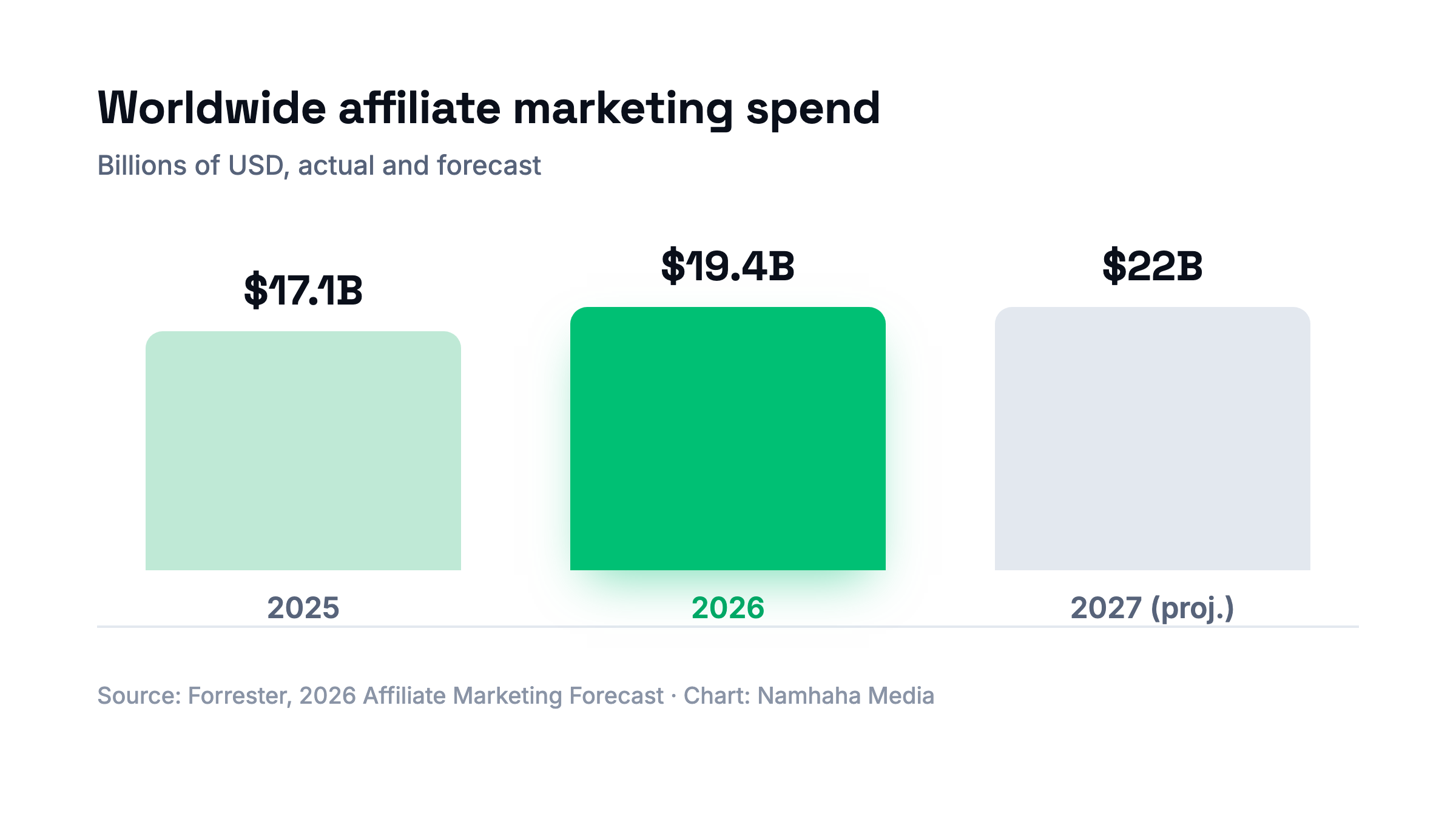
    The five affiliate marketing trends that matter in 2026: partner recruitment has replaced software as the bottleneck, media buyers have overtaken bloggers as the partners that move revenue, server-side tracking has become the attribution baseline, payment speed now decides who joins your program, and AI search is rewriting which affiliate content wins. Worldwide affiliate spend reaches $19.4 billion in 2026, up from $17.1 billion in 2025 (Forrester, 2026 Affiliate Marketing Forecast).

    One more thing before the details: most trend articles in this category are written by people selling affiliate software. I am the partner your new program is trying to recruit. My team evaluates hundreds of affiliate programs every month, joins the good ones, and quietly skips the rest.

    TL;DR

    • Worldwide affiliate spend hits $19.4 billion in 2026, up from $17.1 billion in 2025 (Forrester, 2026 Affiliate Marketing Forecast).
    • Recruiting productive partners is the hard part now; 5% of affiliates drive roughly 80% of program results (affiliate researcher Geno Prussakov’s 5-80 rule).
    • Serious partners judge your program on three numbers: payout percentage, attribution window in days, and days-to-payment.
    • Affiliate programs that rely on browser cookies alone undercount partner sales; server-side (postback) attribution is the 2026 baseline.
    • Partners screen programs with software before a human ever reads your terms. Write your program page for both audiences.

    Why are so many companies adding affiliate programs in 2026?

    Affiliate spend keeps outgrowing most other acquisition channels: Forrester’s 2026 Affiliate Marketing Forecast puts worldwide affiliate spend at $19.4 billion in 2026, up from $17.1 billion in 2025 and on track for $22 billion by 2027.

    Bar chart: worldwide affiliate marketing spend, 17.1 billion USD in 2025, 19.4 billion in 2026, 22 billion projected in 2027 (Forrester)
    Worldwide affiliate marketing spend, 2025-2027. Source: Forrester, 2026 Affiliate Marketing Forecast.

    The logic is easy to like. You pay after the customer arrives, not before, and in a year when paid-media costs keep climbing, “commission on results” is the easiest budget line to defend.

    Here is what the software vendors skip. Roughly 70% of affiliate programs generate less than $500 a month, and most failed programs die within their first six months (Synergist Digital Media, 2025). Opening the program is the cheapest step you will ever take. The gap between the winners and the graveyard is not the tracking tool. It is everything below.

    Trend 1: Why did the bottleneck move from software to partner recruitment?

    In 2026 a company can launch a technically perfect affiliate program in one afternoon, which is why a technically perfect program no longer differentiates anything. Dub Partners, Rewardful, Tolt, PartnerStack, Impact, Awin: the tooling is mature, cheap, and largely interchangeable at launch. Every competitor in your category has access to the same stack.

    Productive partners are the scarce resource. A healthy SaaS affiliate program sees only 10-20% of its affiliates actively driving clicks or sales in a given month (Rewardful, State of SaaS Affiliate Programs, accessed July 2026). Affiliate researcher Geno Prussakov, who has published program benchmarks since the late 2000s, compressed that concentration into the 5-80 rule: 5% of your affiliates will drive about 80% of your results.

    I see this from the inside. When my team joins a new program, the welcome email usually celebrates like we are partner number 300. Then I look at the leaderboard data some networks expose, and it is a desert: hundreds of signups, a handful of names producing revenue. The program owner spent a launch quarter collecting ghosts.

    So skip the question “which affiliate software should we pick?” Ask instead: who are the 15 partners that will carry this program, and what would make them choose us over the 40 other programs in our category? Answer that before you buy anything.

    Trend 2: Why do media-buyer affiliates matter more than bloggers in 2026?

    The affiliate stereotype is a blogger with a review site, but the partners moving revenue for AI and SaaS companies in 2026 are media buyers who treat your offer like their own product launch. They run Google, Bing, Meta, and YouTube traffic to your funnel, front the ad budget themselves, and get paid only when your customer converts.

    I know because that is what we do. In the first half of 2026 my team put $4M of our own ad spend behind partner offers across four ad platforms. We rarely touch brand-name keywords; we buy the demand your future customers type when they do not know you exist yet: competitor comparisons, “best X for Y” queries, problem searches.

    On one enterprise network alone, Namhaha Media’s internal watchlist tracks 763 affiliate programs where at least one partner has been running Google Ads for 30 or more consecutive days (internal tracking, June 2026). Thirty days of continuous spend means the math works. That is the strongest program-quality signal I know of, and no network dashboard will show it to you.

    Designing for media buyers means three things:

    • Publish a paid-traffic policy. Say clearly what is allowed: paid search on non-branded terms, social ads, comparison landing pages. Vague terms read as “we will claw back your commissions later,” and serious buyers leave.
    • Give partners a funnel, not just a link. The programs we scale hardest give us dedicated landing pages or at least allow pre-landers.
    • Expect attribution questions before creative questions. A media buyer’s first three questions are about tracking and payment, never about banner sizes.

    (Aside: bloggers still matter, especially now that AI search engines quote them. But bloggers compound slowly, while media buyers show you within 60 days whether your unit economics survive cold traffic. You want both, and they need different things from you.)

    Trend 3: Why is server-side tracking now the baseline for affiliate programs?

    An affiliate program that attributes sales with a browser cookie alone is underpaying its partners, and the partners find out first. Apple’s Intelligent Tracking Prevention has capped client-side cookies at 7 days for years, and at 24 hours for links carrying tracking decoration (WebKit.org). Ad blockers and iOS privacy prompts cut deeper. Every conversion the cookie drops is a commission a partner earned and never sees.

    Let me make that concrete. Early in one campaign, our click logs showed we had sent a brand roughly 100 trial signups in a period where their dashboard credited us with 60. We raised it, politely. The response was a shrug, so the budget moved to a competitor’s program that measured server-side, and that competitor got the next twelve months of our spend. Nobody in that brand’s marketing team ever knew the revenue existed, because their own tracking never saw it.

    Partners compare notes on measurement constantly. The 2026 baseline is server-side: postback URLs (S2S), server-side conversion APIs, and first-party tracking links that survive browsers. We run our own campaigns this way; conversions fire from the server into each ad platform’s API, so the partner, the brand, and the platform all see the same sale.

    If you are launching now, four settings decide whether measurement helps you or bleeds you unnoticed:

    1. Choose a platform that supports postback/webhook attribution out of the box, not cookie-only.
    2. Offer at least a 30-day attribution window. A 7-day cookie on a SaaS product with a 14-day trial is self-sabotage.
    3. Send conversion events server-side to partners who run paid traffic, so they can optimize ad accounts on real data.
    4. Document all of it on your program page. “Server-side attribution, 30-day window, NET-15 payouts” is recruiting copy, not fine print.

    Trend 4: How did payment speed become a recruiting weapon?

    The slowest mainstream affiliate programs take 70+ days to pay a commission after the sale, while the fastest pay weekly, based on Namhaha Media’s tracking of programs across enterprise networks (June 2026). Partners now see this number before they apply. At least one major network exposes average payment time as a field in its partner API, next to approval rate and earnings-per-click; we pull it programmatically, and we sort by it.

    Run the partner’s math. A media buyer fronts ad spend in January, and on a 70-day cycle the commission for a January sale arrives in April. That partner is floating three months of the brand’s customer acquisition cost out of their own pocket.

    They respond the way anyone would. Bid conservatively on the slow payer, or pick the competitor who pays NET-15. I still promote a few slow payers when the commission is exceptional, but I size those budgets smaller, and every serious media buyer I know runs the same arithmetic before their first click.

    Affiliate program payment terms vs. the partners they attract (2026):

    Payment cycle Which affiliates you attract Verdict
    Weekly or NET-15 Media buyers who scale spend fast Best for growth
    NET-30 Most professional affiliates The 2026 standard
    NET-60 Content sites without cash-flow pressure Slow compounding only
    70+ days Affiliates who have not checked yet Quiet recruitment freeze

    The trap for new programs: long payment cycles feel “safe” against refunds and fraud. Solve that with a hold on unverified conversions, not by making every good partner finance your working capital.

    Trend 5: How does AI search change which affiliate content wins?

    Gartner predicted in February 2024 that traditional search engine volume would drop 25% by 2026 as AI chatbots become substitute answer engines (Gartner press release, February 19, 2024), and inside affiliate programs that shift has a specific consequence: the content partners worth recruiting are the ones AI engines cite. ChatGPT Search, Perplexity, and Google’s AI Overviews summarize and quote instead of listing ten blue links.

    What gets cited is content with verifiable specifics: named sources, numbers with dates, first-hand testing. Generic “10 best tools” listicles rewritten from other listicles are exactly what these engines skip. We watch this from the demand side, because the comparison pages we build for partner offers only earn AI citations when they carry something checkable.

    For a program owner the move is simple, and almost nobody makes it. Give partners real material: internal benchmarks, screenshots, usage data, founder quotes. A partner armed with specifics gets quoted inside AI answers; a partner paraphrasing your homepage does not. And when a small site applies to your program, ask where their content shows up in AI answers instead of staring at their pageview count. A site with 3,000 monthly visitors that Perplexity cites in your category can out-convert a general site with 300,000.

    My honest take: this is the trend most program owners will read, nod at, and ignore, because “give partners proprietary material” requires internal work that “raise the commission 5%” does not. The programs that do the work will own AI-search distribution in their category for years.

    What do affiliates check before joining your program? (Steal this checklist)

    My team screens affiliate programs with software because the volume is too high to do by hand, and the screening list below came from years of joining programs that wasted our time. Every item is something you control on day one:

    1. A commission I can model. Flat or recurring, on what base, for how long. Recurring SaaS commissions of 20-30% for 12+ months beat a large one-time bounty for us, because they reward retention work.
    2. Attribution method. Postback/server-side or cookie-only? What window? (See Trend 3.)
    3. Days to payment. Under 30 is competitive. Over 60 attracts only partners without cash-flow pressure. (See Trend 4.)
    4. A human who answers. We email every program before scaling. A reply within 72 hours carrying real answers predicts program quality better than any commission number.
    5. Terms a machine can parse. Our automation reads your program page before I do. If your paid-traffic policy, cookie window, and payout terms are buried in a PDF or missing, you fail screening without a human ever seeing you.

    That fifth point surprises every founder I mention it to, so let me say it plainly. Partners now use automation to discover, screen, and even apply to programs at scale; my team files hundreds of applications a month this way. The programs with machine-readable terms get the applications from serious operators. The rest get silence and wonder why.

    When should you NOT launch an affiliate program?

    An affiliate program amplifies unit economics; it does not create them. After seven years on the partner side, I would tell a founder to wait if any of these are true:

    • Your funnel does not convert your own traffic yet. If your paid campaigns cannot turn a click into a customer profitably, partners cannot either. We test a brand’s own funnel before committing budget, and a leaky funnel is an instant pass.
    • Your LTV cannot fund a real commission. If paying 20-30% recurring (SaaS) or 25-50% of first order (DTC) breaks your math, the program will attract nobody worth having.
    • You cannot pay within 30 days. See Trend 4. If cash flow forces 60+ day payouts, fix that first.
    • Nobody owns it internally. A program without an owner stops answering email in month two. Partners notice within weeks, and word travels through partner communities faster than most founders expect.

    None of these are permanent. But launching before they are fixed burns your first impression with exactly the 5% of partners who would have carried the program, and in most niches that group all knows each other.

    What did 7 years on the partner side teach me?

    Namhaha Media’s first two years were fintech offers, where we drove 300,000 users and learned attribution the hard way: our click logs and the network dashboards kept telling two different stories, and the difference was our margin. We moved into health and wellness, pivoted to AI and SaaS in 2024, and have now sent 500,000+ customers to partner brands.

    Across all three niches one pattern never changed. The brands that grew fastest through partners rarely paid the highest commission; their programs were simply run by someone who understood the partner’s economics, meaning fast payment, honest attribution, real answers by email, and terms you could read in two minutes.

    That is the entire secret, and it is why “trends” is almost the wrong word for this article. The tooling changes yearly. The winning behavior has been identical since our fintech days; 2026 just punishes laggards faster, because partners now share data and screen programs with software.

    Where Namhaha Media fits (and where we do not)

    We are a growth partner for AI and SaaS companies, and this article doubles as a disclosure: we make money as an affiliate ourselves, so everything above is how we genuinely allocate budget. It is also why brands hire us. We grow their revenue with the same playbook we run on our own campaigns, from customer research to paid acquisition across Google, YouTube, Meta, and Bing. We do not sell tracking software or own a network, so we have no stake in which platform you pick.

    Concretely, an engagement starts with the screening report from the checklist above, then an agreed target, then we build and run the acquisition side while you keep ownership of the program. One direct contact, and a written insight report on what your customers respond to, every week.

    If you are planning an affiliate program, or you launched one and the leaderboard is a desert, that is the conversation we are built for.

    Talk to the team that evaluates affiliate programs for a living

    Send your program page. You get back the same screening our software runs on every program we join: where you fail, what we would fix first, and whether we would personally promote you. Free, and no slide deck.

    Get my straight assessment

    FAQ: launching an affiliate program in 2026

    What commission rate should a SaaS affiliate program offer in 2026?

    A competitive SaaS affiliate commission in 2026 is 20-30% recurring for 12 months to lifetime. One-time bounties suit high-ACV products with sales-assisted closes, but recurring commissions attract affiliates who care about the quality of customers they send, not just volume (Namhaha Media screening data across 7 networks, 2026).

    How long does a new affiliate program take to produce meaningful revenue?

    A new affiliate program that actively recruits partners typically needs one to two quarters before commissions become meaningful, because most program revenue comes from a handful of partners (the 5-80 rule). Programs that launch and wait usually stay under $500 a month, where roughly 70% of all programs sit (Synergist Digital Media, 2025).

    Do I need an affiliate network, or is a self-hosted tool enough?

    Start with the lightest tool that supports server-side attribution and fast payouts; add an enterprise network later for discovery. Network marketplaces are where partners’ screening automation looks first, while self-hosted tools give lower fees and more control but zero built-in reach.

    How do I attract media-buyer affiliates specifically?

    Media buyers join affiliate programs that publish an explicit paid-traffic policy, offer a 30-day server-side attribution window, pay NET-15 or NET-30, and provide landing pages or allow pre-landers. Then show up where they already evaluate offers: network marketplaces with complete terms, and direct outreach that leads with your funnel metrics.

    Restrict branded keywords and trademark-plus terms in writing, allow everything else, and enforce with monitoring rather than blanket bans. Affiliates bidding your brand name add little incremental value, while affiliates bidding competitor and problem keywords bring customers who did not know you existed. Ban the first, encourage the second.


    About the author

    Nam Nguyen is the founder of Namhaha Media, a growth partner for AI and SaaS companies. His team has spent 7 years on the partner side of affiliate marketing across fintech, health, and software, managing $4M in ad spend in H1 2026 across Google, YouTube, Meta, and Bing, and driving 500,000+ customers to partner brands. Contact: namhahamediallc.com.

    Sources

    • Forrester, 2026 Affiliate Marketing Forecast: worldwide affiliate spend of $19.4B in 2026, $17.1B in 2025, $22B by 2027 (figures as reported in FirstPromoter’s statistics roundup and DigitalApplied’s 2026 data compilation)
    • Gartner, press release, February 19, 2024: traditional search engine volume predicted to drop 25% by 2026 due to AI chatbots
    • Rewardful, State of SaaS Affiliate Programs (accessed July 2026): active-affiliate benchmarks (10-20% of partners active monthly)
    • Geno Prussakov, the “5-80 rule” of affiliate program concentration (long-running benchmark from his affiliate program research, accessed July 2026)
    • Synergist Digital Media, Why Most Programs Fail (2025): ~70% of programs under $500/month; most failures within six months
    • WebKit.org, Tracking Prevention: ITP 7-day / 24-hour cookie caps
    • Namhaha Media internal tracking data, June 2026: 763-program watchlist, payment-time observations, screening benchmarks

    Last updated: July 6, 2026